Monday, February 21, 2011
Why?
In the Graduate Seminar class that the majority of the ceramic graduate class is in, there has been a lot of discussion pertaining to conceptual art. There seems to be an abundance of lackadasical objects floating around in the artworld with pages of concept supporting the objects. My question is, why do people spend so much time trying to prove the worth of an object they spent all of five minutes obtaining? It just seems to me, that if you are an excellent writer, then why try to pass yourself off as an object maker? Why not just become a theorist, or a philosopher? And more so, why are these "artists" being supported by major contemporary museums?

Friday, February 18, 2011
MAGDALENE GLUSZEK WORKSHOP

Hello Everyone! Please stop by this coming Wednesday and Thursday, February 23rd and 24th, to see our visiting artist, sculptor Magda Gluszek.
She will be demonstrating both days from 9 a.m. to 5 p.m., and she will be giving an artist talk on Wednesday night in the East Hall Classroom at 8:30 p.m.
We look forward to seeing you all there!
Monday, February 14, 2011
Is Thomas kinkade an artist or a craftsman? Paint versus Clay
I have found that in the realm of ceramics, there is often a stigma attached to clay. Outside of the people that actually work with clay, there seems to be a popular misconception that clay working can only be craft, and not fine art. I personally believe that it is not what you use to make your work (artwork), but it is the thought, passion and ideas that lead you to make an object or image that define whether or not something is fine art, craft, or design. That is not to say that one is better than the other (craft versus fine art); that is an entirely different debate.
Most of us know of the popular paintings of Thomas Kinkade. Because Kinkades medium is paint, he is often advertised as an artist, but when your work becomes production is it still art? Perhaps his first original paintings were art because he had an idea or a vision, but now, after they have been mass-produced is it still art, or is it craft? Or, is it something else? I leave this entry as an opening into the discussion of art versus what?. Feel free to add your two cents to this topic . . .
The Allure of the Human Face
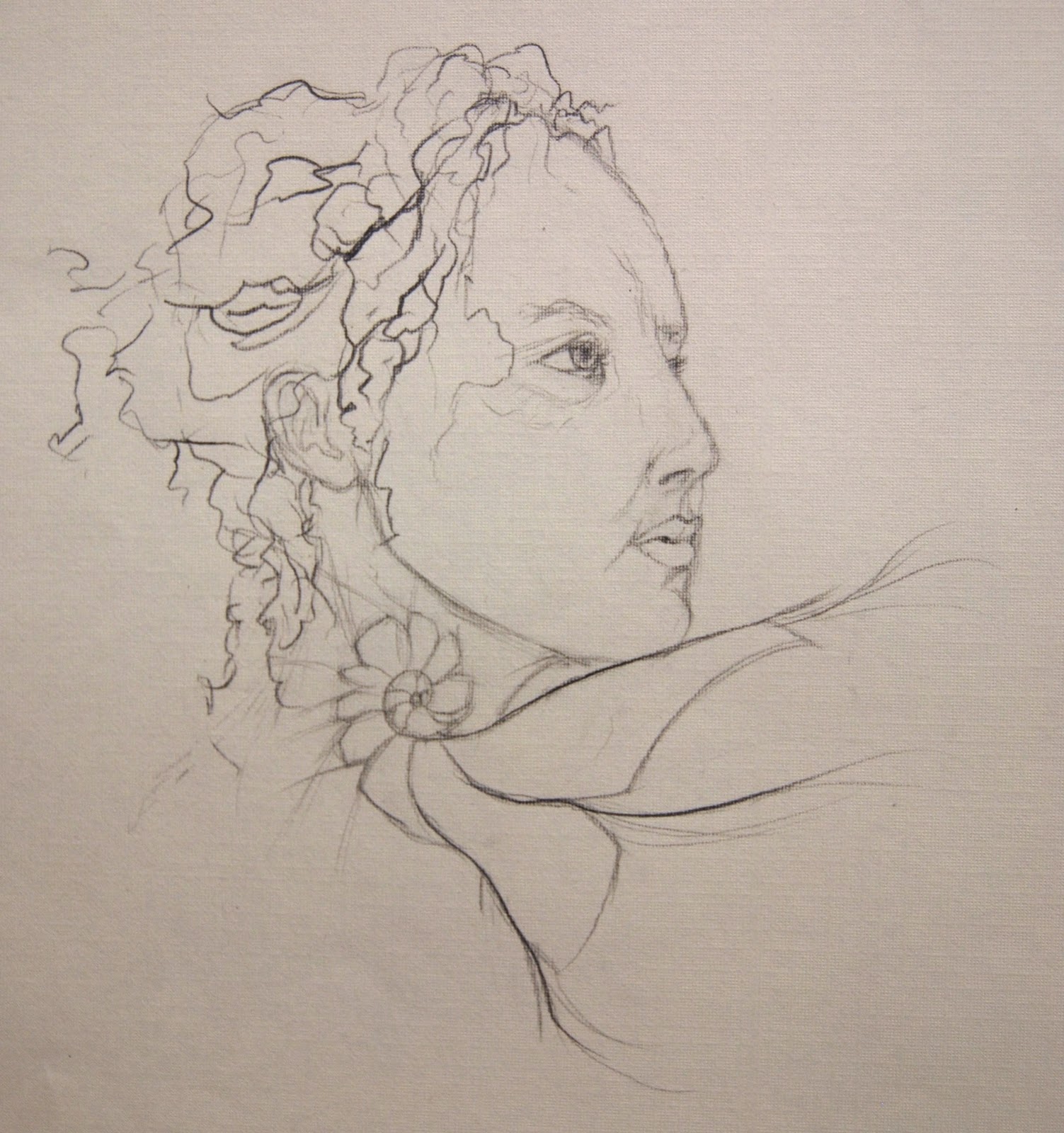
I find myself compelled to integrate imagery of the human face into much of my work. A persons face can act as a window into their thoughts. I look at the physical body, or a persons face, as a shell we can often hide behind; but also as a way to express our thoughts, and emotions. This is one reason in particular that you will often find faces emerging from sections of my work.
Sunday, February 6, 2011
Layers of the Spiral

Spirals have been used symbolically throughout the ages of humanity to represent an abundance of ideas and philosophies of the human spirit, as well as representations of nature and the universe. A spiral is probably one of the most recognized symbols throughout the world, used and manipulated for what ever purpose we choose. It can represent the the centering, layering, or abundance of one's thoughts or self, while also representing the spiral of life and existence. Perhaps there is a deeply embedded reasoning in the human psyche for our connectivity to spiral imagery. With the questions, emotions, and ideas that drive my work, I certainly see, and feel, an appropriateness when integrating this type of symbolism.
Why the crow?


Wednesday, January 26, 2011
Sketchbook Mentality
In general, when you think of a sketchbook, most tend to think of a book filled with blank pages in which a person draws out ideas and sketches images. Though I have many of these "traditional" sketchbooks, I also consider other pieces of work to be a part of that sketchbook mentality. Drawings, clay test tiles, smaller sculptures etc. . . are all a part of my sketchbook. In the past, I have shied away from showing people my "sketches," feeling they were private pieces unintended for others to see. I do, however, believe that it is a significant part of my thought process, and helps to inspire larger pieces. For my thesis show, I am including a small sketchbook area in which I will compile pieces I feel are significant to display. I have added some images below of just a few "sketches," or smaller works.



Mini shadow boxes made from Whitman's chocolate sampler boxes
My Last Semester
This is the Beginning of my last semester in the Edinboro MFA program. Three years Fly by incredibly fast. My recent days feel mushed together in one big blur. It's exciting, and I am really enjoying my work. Yet, it is also terrifying knowing I am facing that inevitable job search. Currently, my work is focused on developing pieces specifically suited for my thesis show. I have added a few images of work that has just recently been completed.
The imagery of much of this work is compelled by my personal questions of existence, human spirituality, and our "sixth sense," (intuition), as well as the way in which different societies and religions might also view humanity. For instance, why do so many religions throughout the world feel a need to assimilate the traits of animals to the "human spirit?" What are the traits of humanity, and why do we need to assimilate them with anything? (Somehow, personally speaking, comparing humanity to the natural environment and the life that lives in that environment, for me, helps describe the connection between us and the world we live in.) Where does the body end and the spirit start? Does it exist at all? Do we exist at all? We live in a world of beginnings and endings. Everyone is born, everyone dies. Humans by nature seem to be in constant search of the great answers of life. Some of us are content, or comforted with the answers handed down through religion from one generation to another answering those big questions of where we came from. Other people take a scientific approach, and yet others question it all. If life begins with water, then where did water come from? Where did the world come from? Where did the Universe come from, and in turn, where did the place that the universe come from, come from? If we live in a world with this theory of time, while also living with a sense of beginnings and endings, and, in the grand scheme of things, not being able to see a beginning or an ending to time or the universe, then how is existence a possibility? Yet, here we are . . .


The images above are taken of a piece I have been working on for the last few months. It is a wall piece that is approximately eight feet tall by eight feet wide. It is a representation of many of my above questions, with life emerging from its crusty beginning spiraling out in layers of life, and questions.
Tuesday, October 5, 2010
SUMMER RAKU WORKSHOPS 2010
This summer I taught a series of Raku workshops twice a week for 6 weeks, along with two additional workshops this fall. Below are some photographs taken from those workshops at Bill Campbell's Studio in Edinboro Pennsylvania. The workshops were split into two days per group. On day one, we made coil bowls using clay molds. We went over the history of how puki pots were used in Pueblo Indian pottery, and how it related to the building process we were using to create our own pots in the workshop. In between classes I fired the student work, and on day two, we glazed and fired the bowls using the Raku firing process.


I dug through an absorbant amount of gunk to find the missing piece to this lovely bowl. The things you do for your students!


A FIGURE MODELING CLASS I TAUGHT THIS SUMMER


Here are some photographs of student work from the figure modeling class I taught over the summer for the Cattaraugus Arts Council in Allegany NY. For the majority of the students, this class was their first experience working with clay. There was a live model throughout the series of classes taught.


Although I have taught many ceramic classes, this was the first class I taught solely focused on the figure. The experience was challenging. It was exciting to encourage and watch students discover clay and the figure.
Subscribe to:
Posts (Atom)